
Description
PrymaLab · Research Use Only
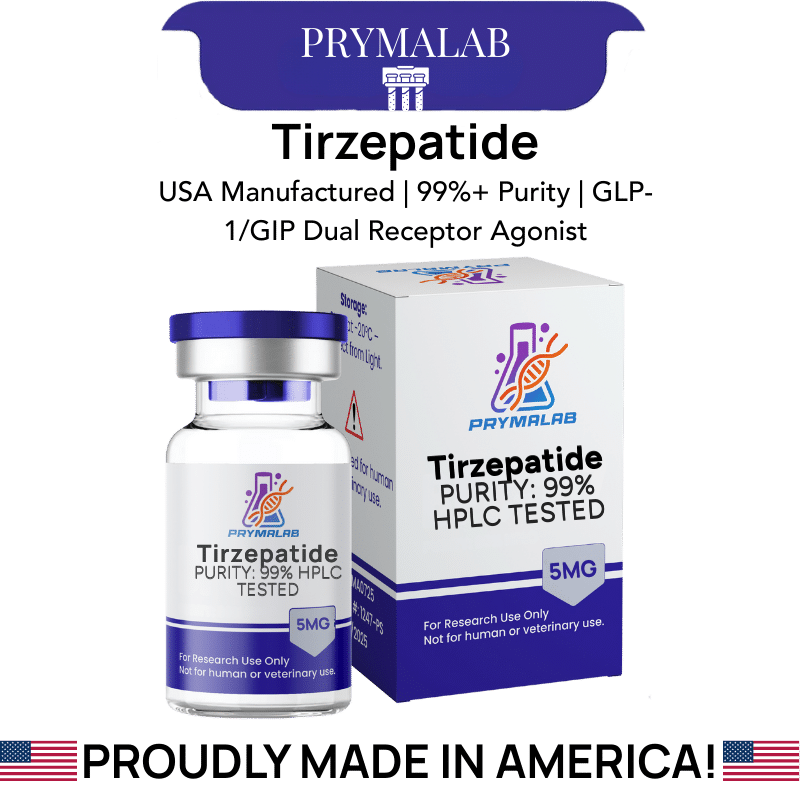
Tirzepatide 5mg
The smallest fill is where the counterion costs you most
Tirzepatide 5mg is the smallest of ten fill sizes in this catalogue and the compound in it is identical to the compound in all the others. What differs is how much of the vial mass is peptide, and how far one vial goes.
Specification Table
| Property | Value |
|---|---|
| Compound | Tirzepatide |
| Development code | LY3298176 |
| CAS number | 2023788-19-2 |
| Declared content | 5 milligrams |
| Molecular weight | Approximately 4.8 kDa. Read the exact figure from the lot certificate |
| Approximate molar content | Around 1 micromole |
| Position in the range | Smallest of ten fills, from 5mg to 100mg |
| Compound differences between fills | None. The molecule is the same in every one |
| Acylation | A C20 fatty diacid, which affects both handling and net content |
| Vial mass versus peptide mass | Not equal. Counterion and residual water make up the difference |
| Net peptide content | A percentage, so it removes the same share from every fill size |
| Consequence at this fill | That share is the largest fraction of the quantity being measured |
| Reconstitution note | Choose diluent volume against target concentration, not by habit |
| Pharmacology | Covered on the 10mg page. It does not change with fill size |
| Storage | Sealed at minus 20°C. Do not freeze solution and do not agitate |
What Does a Tirzepatide 5mg Vial Actually Contain?
A tirzepatide 5mg vial holds less peptide than the label says, in the ordinary way that every synthetic peptide vial does.
A peptide carrying basic residues comes off its purification column as a salt. The counterion is part of the vial mass and is not peptide.
Residual water adds to that, since a lyophilised cake is never completely dry.
Net peptide content is the number that resolves it, determined by nitrogen or amino acid analysis and stated as a percentage.
Because it is a percentage, it takes the same proportion out of a 100 milligram vial as out of this one.
What changes is what that proportion means in the context of the experiment.
A study using a large fill is usually running many conditions, and a systematic ten percent offset across all of them shifts every point in the same direction, which a within-study comparison partly absorbs.
A study using a 5 milligram vial is usually running few conditions, sometimes one, and there is nothing for the offset to be absorbed against.
So the same percentage error is more visible and less recoverable here, and it is the reason I would ask for the net content figure on a small fill even if I would not chase it on a large one.
Why Is This the Riskiest Fill to Buy?
Nothing is wrong with the article. The risk in a tirzepatide 5mg purchase is about who buys it and why.
A 5 milligram vial is what somebody purchases to find out whether a compound is worth working with. It is a trial quantity, bought before the study exists.
The number that comes out of that first experiment then becomes the reference for everything after it, and everything after it comes from a different vial and usually a different lot.
That is a comparison across materials being read as a comparison across conditions, and it happens constantly.
The fix is unglamorous. Record the lot on the pilot, and when the definitive work starts, either buy from the same lot or accept that the pilot is a range-finding exercise rather than a baseline.
I would go further and say a pilot result on a peptide should never be reported alongside definitive results as though the two were commensurable, unless the lot is the same.
Nobody does this. It costs one line in a notebook.
What Concentration Does 5 Milligrams Give?
At roughly 4.8 kilodaltons, a tirzepatide 5mg fill works out at around 1 micromole of material.
Reconstituted into 1 millilitre that is about 1 millimolar. Into 2 millilitres, roughly 500 micromolar.
Both are far above anything a receptor assay uses, so the fill is not a constraint on concentration. It is a constraint on volume.
One micromole spread across a dilution series and multiple replicate conditions goes faster than the number suggests, particularly once adsorption losses are accounted for.
The habit worth breaking is reconstituting into a round number of millilitres regardless of fill size.
Choosing the volume so that the stock concentration matches the one used on a larger fill keeps the downstream dilution series identical, which removes a transcription error and makes two datasets directly comparable.
That matters more on a ten-size family than it would on a compound sold in one presentation.
What Should the Certificate Show?
Net peptide content, with the determination named. This is the one the page is about.
The full sequence with the acylation position stated.
Observed mass by spectrometry, since incomplete acylation produces a species with a predictable mass difference.
Purity by chromatography with the method named.
Aggregate content by size exclusion chromatography, which matters on an acylated peptide.
The salt form, because the counterion identity changes the arithmetic and trifluoroacetate has documented effects of its own in cell systems.
Lot number and manufacturing date.
A certificate quoting purity without net peptide content has told you what fraction of the peptide present is the right peptide, and nothing about what fraction of the vial is peptide at all. Those are different questions and the second one is the one that sets your concentration.
What Does a Ten-Size Range Imply?
That somebody expected this compound to be bought at very different scales, and a tirzepatide 5mg vial is the bottom of that range.
Ten fills from 5 to 100 milligrams is a range of twenty to one. Nothing else here is offered across that spread.
The reason is that the published work on this compound spans single-well assays and animal studies, and those consume quantities that differ by orders of magnitude.
For a buyer the practical effect is that the range removes an excuse. On an article sold in one size you buy what exists. Here the correct size exists and choosing wrongly is a decision rather than a constraint.
What the range also does is create a comparability problem that a single-size article does not have.
Ten sizes means ten filling runs, and a laboratory that buys a different size each time it reorders is accumulating lots without noticing, because the lot number changes and the size change is what draws attention.
A buying record that lists sizes is therefore a rough proxy for a lot record, which is not something anybody sets out to build and is useful once it exists.
What Belongs in a Methods Section?
More than most peptide methods sections carry, and the additions are cheap.
Compound name and supplier are standard fields and nobody omits them. The lot number is not, and it should be.
Net peptide content, because without it a stated concentration is a nominal figure derived from vial mass rather than from peptide mass.
The vial size. On a ten-size article that tells a reader how many lots a dataset spans.
The diluent and the exact volume added, since that is what converts a mass into a concentration.
The reconstitution date and the date each measurement was taken, because the interval between them is the solution age.
Six fields, four usually absent. Together they let somebody else work out whether their result should match yours.
I have read a lot of peptide methods sections and the ones that carry all six are rare enough that I notice them.
What Is Identical Across the Range?
Almost everything, and listing it is quicker than listing the differences.
The sequence, the acylation, the two aminoisobutyric acid substitutions, the receptor pharmacology, the imbalance between the two arms and the signalling bias at one of them. All of it is a property of the molecule.
The purity specification, the storage temperature, the reconstitution method and the handling rules are also common to every fill.
What differs is the amount in the vial, the number of lots a study spans, and the relative weight of fixed reconstitution errors.
Three things, and none of them is chemistry.
That is why this page defers to the 10mg anchor rather than restating it, and why a listing that describes a fill size as though it were a different product is describing a purchase.
How Should the Vial Be Handled?
Handle a tirzepatide 5mg vial as an acylated peptide, which the 10mg page covers in full. The differences at this fill are volume, not chemistry.
Sealed lyophilised powder holds at minus 20 degrees Celsius, dark and dry.
Bring the vial to ambient temperature before opening. A 5 milligram cake is small, and cold glass in a warm room collects enough water to matter on a fill that size.
Add diluent down the wall and let the cake dissolve without agitation.
Do not vortex. The fatty acid chain makes the molecule surface active and an air-liquid interface is where it associates.
Do not freeze the reconstituted solution.
Rinse the vial with a second small volume of diluent. On a small fill the material left on the glass is a larger share of the total and the rinse recovers a useful fraction of it.
Aliquot on first reconstitution.
Record lot, net peptide content, salt form, the diluent and its exact volume, storage temperature and the reconstitution date.
Exact volume rather than nominal volume. On a small fill the difference between what you meant to add and what you added is a larger share of the answer.
One last thing about small fills generally. The rinse step described above recovers material that would otherwise stay on the glass, and on a 5 milligram vial that recovery is a measurable share of the total rather than a rounding correction.
Published Literature
Selected references on the receptor pharmacology, on the structural basis of dual engagement and on peptide storage generally. The 10mg page carries the same list, since the compound is the same.
- Willard FS, Douros JD, Gabe MB, Showalter AD, Wainscott DB, Suter TM, et al. JCI Insight. 2020;5(17):e140532. DOI: 10.1172/jci.insight.140532
- Sun B, Willard FS, Feng D, Alsina-Fernandez J, Chen Q, Vieth M, et al. Proceedings of the National Academy of Sciences. 2022;119(13):e2116506119. DOI: 10.1073/pnas.2116506119
- Frias JP, Davies MJ, Rosenstock J, Perez Manghi FC, Fernandez Lando L, Bergman BK, et al. New England Journal of Medicine. 2021;385(6):503-515. DOI: 10.1056/NEJMoa2107519
- Manning MC, Chou DK, Murphy BM, Payne RW, Katayama DS. Pharmaceutical Research. 2010;27(4):544-575. DOI: 10.1007/s11095-009-0045-6
Frequently Asked Questions
Is the compound different in a 5mg vial?
No. The compound in a tirzepatide 5mg vial is identical to the compound in all ten fill sizes. Only the amount differs.
What is net peptide content?
The fraction of the vial mass that is peptide rather than counterion and residual water. It is determined by nitrogen or amino acid analysis and stated as a percentage.
Does it differ between fill sizes?
No, because it is a percentage. It removes the same proportion from a 100mg vial as from this one.
So why does it matter more here?
Because a study using a small fill usually runs few conditions, and a systematic offset has nothing to be absorbed against. On a large fill spread across many conditions, a within-study comparison partly absorbs it.
Why is this fill described as risky?
Because of how it gets used. It is a trial quantity bought before a study exists, and the number from that first experiment becomes the reference for later work done on a different lot.
What is the fix for that?
Record the lot on the pilot. When the definitive work starts, either buy from the same lot or report the pilot as range-finding rather than as a baseline.
How much is 5 milligrams in molar terms?
At roughly 4.8 kilodaltons, around 1 micromole. Reconstituted into 1 millilitre that is about 1 millimolar.
Is the fill a constraint on concentration?
No. It constrains volume. One micromole goes faster than the number suggests once a dilution series, replicates and adsorption losses are counted.
How should diluent volume be chosen?
So the stock concentration matches the one used on a larger fill. That keeps the downstream dilution series identical across fill sizes and removes a transcription error.
Should the vial be rinsed?
Yes, on a small fill. Material left on the glass is a larger share of the total and a second small volume of diluent recovers a useful fraction.
What certificate field matters most here?
Net peptide content. Purity tells you what fraction of the peptide present is correct. Net content tells you what fraction of the vial is peptide, and that is what sets your concentration.
Where is the pharmacology covered?
On the 10mg page. Imbalanced receptor engagement and signalling bias do not change with fill size, so they are not repeated here.
Compliance Statement
Tirzepatide is sold exclusively for laboratory research use. It is not a drug, food, or cosmetic product, and it is not a dietary product of any kind. It is not approved by the FDA or any comparable authority for human or veterinary use, vial mass includes counterion and residual water and is not equivalent to peptide mass, a result generated on one lot cannot be compared directly against a result generated on another without the net peptide content figure for both, it engages two receptors unequally and published findings cannot be attributed to either without a receptor-null system or a selective antagonist run alongside, and no compound in this range is offered for any human or veterinary purpose. This product is not intended to diagnose, treat, cure, or prevent any disease. It must not be given to humans or animals. Purchase is restricted to qualified researchers and institutions operating within applicable laws. All handling is the responsibility of the purchasing laboratory.
Other formats of Tirzepatide
Tirzepatide is also stocked as Tirzepatide 10mg, Tirzepatide 15mg, Tirzepatide 20mg, Tirzepatide 30mg, Tirzepatide 40mg, Tirzepatide 50mg, Tirzepatide 60mg and Tirzepatide 80mg. Each listing states its own quantity and concentration, and the pen and vial comparison explains what changes between formats.










18 reviews for Tirzepatide 5mg